Electricity Bill Calculator Pakistan - LESCO NEPRA Slabs 2026-27
Calculate electricity bills for LESCO, MEPCO, FESCO, K-Electric using NEPRA FY 2026-27 slabs. Learn protected vs non-protected slabs, FPA, TV fee, and meter rent.
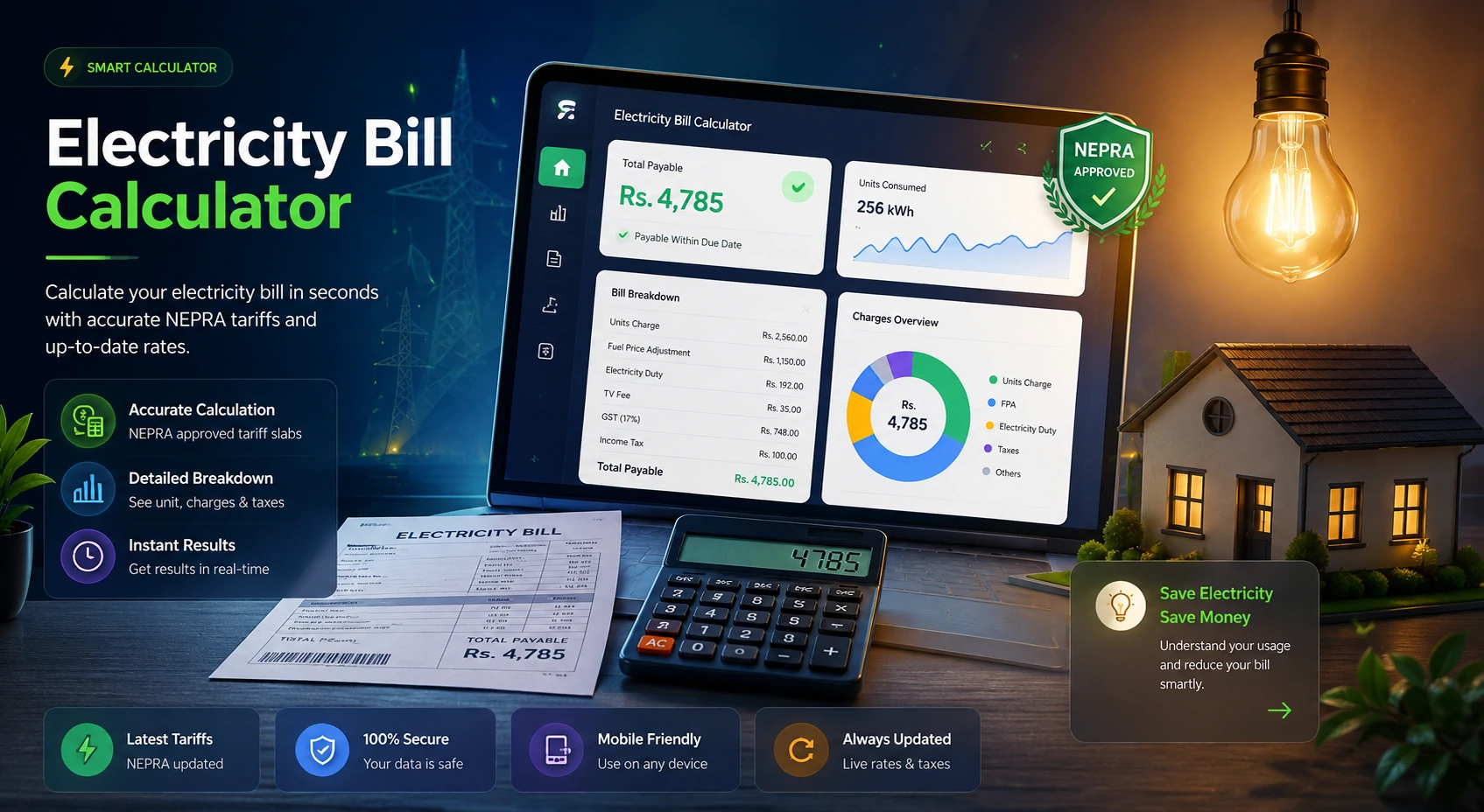
Electricity bills in Pakistan confuse millions of domestic consumers. Two adjacent households with similar lifestyles can pay dramatically different bill amounts because of how NEPRA defines Protected vs. Non-Protected consumer status, fuel price adjustments (FPA), quarterly tariff adjustments (QTA), and federal surcharges. Our Electricity Bill Calculator Pakistan helps you accurately estimate your bill using the latest uniform NEPRA residential slabs.
Pakistan domestic electricity billing (LESCO, MEPCO, IESCO, FESCO, K-Electric, etc.) operates under a flat-slab system set by NEPRA. Subsidized “Protected” consumers pay lower unit rates (Rs. 10.54 to Rs. 13.01) if they consume under 200 units for 6 consecutive months. Once you cross 200 units, you are classified as “Non-Protected” for the next 6 months, where unit rates scale aggressively up to Rs. 43.95/unit. Government taxes, fuel price adjustments (FPA), quarterly adjustments (QTA), and surcharges typically add another 35% to 45% to your final payable bill.
Protected vs Non-Protected Consumers
NEPRA classifies domestic residential consumers into three primary billing schedules:
- Lifeline Consumers: Consistently under 100 units/month, single-phase connection, with heavily subsidized rates of Rs. 3.95 (0-50 units) and Rs. 7.74 (51-100 units).
- Protected Consumers: Domestic consumers who consume less than 200 units per month consistently for 6 consecutive months. They enjoy subsidized rates from Rs. 10.54 to Rs. 13.01.
- Non-Protected Consumers: Standard consumers who exceed 200 units in a single billing month. They pay higher base rates starting at Rs. 23.59 and going up to Rs. 43.95 per unit. Crossing 200 units once immediately flags you as Non-Protected for the subsequent 6 months.
Official NEPRA FY 2026-27 Residential Tariff Table
The table below outlines the exact uniform base energy charges notified by NEPRA and the Power Division for residential connections:
| Consumer Category / Slabs | Applicable Rate (Rs. / kWh) | Slab Details & Thresholds |
|---|---|---|
| Lifeline Slab 1 | Rs. 3.95 | Consumption from 1 to 50 units |
| Lifeline Slab 2 | Rs. 7.74 | Consumption from 51 to 100 units |
| Protected Slab 1 | Rs. 10.54 | Consumption from 1 to 100 units (Protected) |
| Protected Slab 2 | Rs. 13.01 | Consumption from 101 to 200 units (Protected) |
| Non-Protected Slab 1 | Rs. 23.59 | Consumption from 1 to 100 units (Standard) |
| Non-Protected Slab 2 | Rs. 25.10 | Consumption from 101 to 200 units (Standard) |
| Non-Protected Slab 3 | Rs. 27.04 | Consumption from 201 to 300 units |
| Non-Protected Slab 4 | Rs. 32.53 | Consumption from 301 to 400 units |
| Non-Protected Slab 5 | Rs. 36.38 | Consumption from 401 to 500 units |
| Non-Protected Slab 6 | Rs. 40.31 | Consumption from 501 to 700 units |
| Non-Protected Slab 7 | Rs. 43.95 | Consumption above 700 units |
Source: NEPRA notified uniform residential schedules. Checked against official DISCO tariffs. Rates represent base energy costs; other taxes, fuel cost adjustments, and fixed duties are calculated additionally.
Myth vs. Reality in Pakistani Power Tariffs
❌ Myth: I pay slab-specific rates progressively, like income tax brackets.
✔ Reality: Slabs are flat-rate based.
If your consumption reaches 301 units, NEPRA does not calculate the first 100 at Rs. 23.59, next 100 at Rs. 25.10, etc. Instead, the entire 301 units are calculated at the flat higher rate of Rs. 32.53/unit. This is why a single extra unit can spike your bill by thousands of rupees.
❌ Myth: Peak and Off-Peak hours apply to standard single-phase residential meters.
✔ Reality: Peak/Off-Peak charges only apply to 3-Phase Time-of-Use (ToU) meters.
If you have a standard single-phase residential meter (most smaller houses), you are charged a uniform flat rate for units independent of what hour of the day they are consumed. However, 3-Phase meters track peak vs. off-peak hours separately.
❌ Myth: Solar net metering credits will offset my TV fees, GST, and fixed surcharges.
✔ Reality: Buyback credits only offset variable base energy charges.
Even if you export more solar units than you import, your net bill will not be zero. You must still pay provincial electricity duty, TV fees, FPA surcharges (if applicable on gross imports), and Sales Tax (GST) applied on the positive taxable subtotal.
Household Appliance Power Consumption Benchmarks
Understanding what drives your unit consumption is critical to managing your monthly slab. Here are realistic benchmarks for standard appliances used in Pakistan:
| Appliance | Average Watts | Daily Usage | Est. Monthly Units |
|---|---|---|---|
| 1.5 Ton Inverter AC (set to 26°C) | Avg. 800 W | 8 Hours | 192 Units |
| 1.5 Ton Old Window / Split AC | 1,800 W | 8 Hours | 432 Units |
| Inverter Refrigerator (Medium) | Avg. 120 W | 24 Hours | 86 Units |
| Water Pump Motor (1 HP) | 746 W | 1 Hour | 22 Units |
| Standard Ceiling Fan | 80 W | 12 Hours | 29 Units |
| BLDC Inverter Ceiling Fan | 30 W | 12 Hours | 11 Units |
Additional Charges, surcharges, and Levies
Apart from the basic energy charges, your bill contains several government-notified surcharges:
- Fuel Price Adjustment (FPA): This represents the monthly cost variation of oil, LNG, coal, and gas used in power generation. Approved by NEPRA retroactively and added to bills. It averages Rs. 3.0 to Rs. 7.0 per unit.
- Quarterly Tariff Adjustment (QTA): Covers capacity charges, DISCO transmission line losses, and system adjustments. Added quarterly.
- Financing Cost (FC) Surcharge: Set at Rs. 3.23 per unit to service debts in the energy sector's circular debt.
- Electricity Duty (ED): Standard provincial tax, calculated as 1.5% of the base energy cost.
- General Sales Tax (GST): Federal tax set at 18% applied on the taxable subtotal of all utility components.
- PTV Fee: Flat Rs. 35 for residential connections and Rs. 60 for commercial meters.
⚠️ Common Electricity Bill Mistakes in Pakistan
- Losing 'Protected' Status by 1 Unit: Exceeding 200 units (even by just 1 unit, reaching 201) immediately classifies you as Non-Protected for the next 6 months, nearly doubling your bill.
- Ignoring FPA and Taxes: Assuming only base units determine your bill. Fuel adjustments, surcharges, and GST make up nearly 40% of the bill, so factor them in using our calculator.
- Not Verifying Physical Meter Reading Dates: Meter readers sometimes delay physical readings (e.g. reading on the 32nd day), pushing your consumption artificially past critical slab thresholds.
📋 What to Do After Estimating Your Bill
- Cross-verify physical readings: Go check your physical meter on the reading date listed on your previous bill. If the reader over-recorded, contact your local sub-division office immediately.
- Upgrade to energy-efficient BLDC fans: Replacing 3-4 old fans with BLDC alternatives will reduce your consumption by 80+ units monthly, easily keeping you in the Protected bracket.
- Keep inverter ACs set to 26°C: Do not set ACs to 18°C. Set to 26°C with a ceiling fan for optimal cooling and 30% lower power draw.
- Evaluate solar power options: If your monthly usage is consistently above 300-500 units, a grid-tied solar system with net metering is highly lucrative. Explore our detailed solar calculator guide to estimate rooftop solar savings alongside our dedicated Solar Calculator Pakistan tool.
Check Our Interlinked Pakistani Calculators
Keep your domestic household finances and energy footprints optimized using our suite of calculators:
- Solar Calculator Pakistan — Calculate your optimal solar system size (3kW, 5kW, 10kW), battery backups, cost structure, and net metering payback period.
- Unit Converter Pakistan — Easily convert units of power, energy, area (such as marla to sqft), and other domestic metrics.
- Fuel Cost & Mileage Calculator — Estimate and track vehicle travel costs and compare transportation vs appliance expenses.
Frequently Asked Questions
How is the electricity bill calculated in Pakistan?
The bill is calculated by multiplying your consumed units by the flat NEPRA tariff rate assigned to your category. Surcharges (FPA, QTA, FC) are added per unit, then provincial duty (1.5%) is applied, followed by Federal Sales Tax (18% GST), and flat TV fees.
How can I return to Protected consumer status?
To return to Protected status, you must ensure your household consumption remains strictly below 200 units every month for 6 consecutive months. Once you achieve this 6-month record, your tariff category will automatically revert to Protected.
Does K-Electric use the same residential slabs as LESCO?
K-Electric sets its own tariff structure, but NEPRA coordinates uniform tariff schedules across all of Pakistan to maintain equity, so the base residential slabs are highly aligned across LESCO, MEPCO, IESCO, and K-Electric.
Last Updated: August 6, 2026 | Author: Abaid Awan | Reading time: 8 min | Sources: nepra.org.pk, Federal Board of Revenue (FBR), checkyourbill.pk, NEPRA uniform schedules | Contact: contact@pakcalchub.com
Abaid Awan
Developer & Editor, PakCalcHubDeveloper & Editor of PakCalcHub. Specialized in microsecond client-side calculation models and statutory FBR/NEPRA/SBP formula verification.
Calculate Electricity Bill Calculator Instantly
Zero signups. Microsecond client-side calculations based on latest Pakistan statutory rules.
Salary Tax Calculator Pakistan 2026-27 & 2025-26
FBR salaried tax slabs 2025-26 & 2026-27 with return filing
Use CalculatorRecommended Knowledge Guides
Explore verified Pakistan tax, utility, property, and financial guides.