BMR & Calorie Calculator Pakistan
Calculate Basal Metabolic Rate (BMR), daily calorie needs (TDEE), and weight loss/gain targets using the Mifflin-St Jeor formula tailored for Pakistani diets.
🔥Body & Activity Specs
Mifflin-St Jeor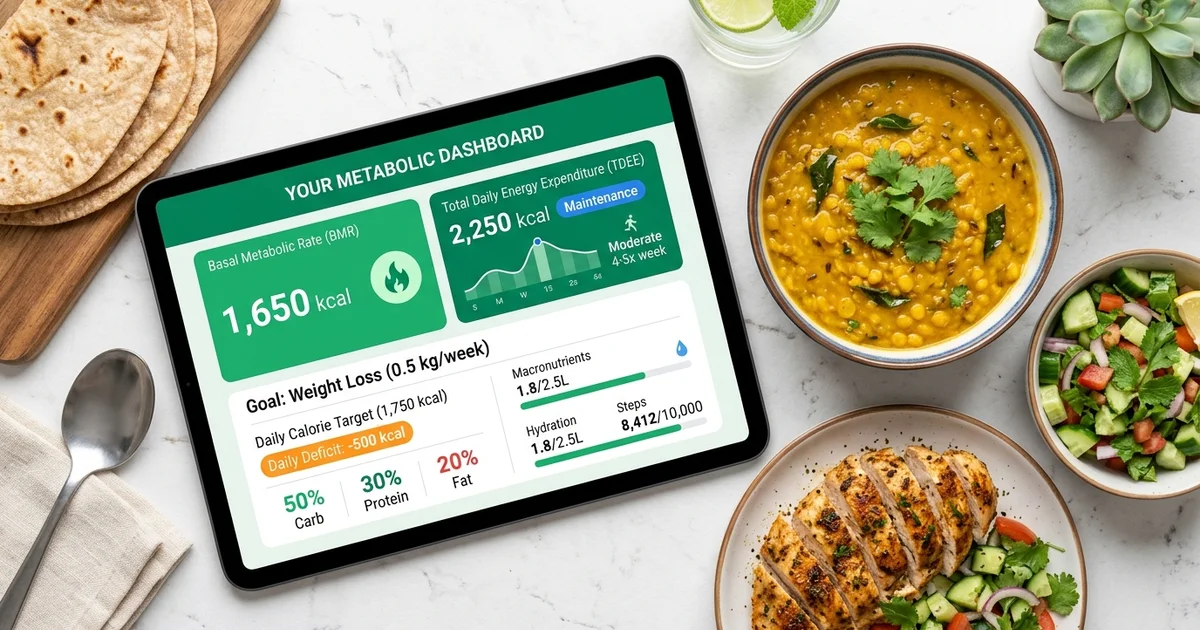
Understanding BMR and TDEE in Pakistan
Managing body weight and energy levels requires an accurate understanding of your metabolic energy burn. Your Basal Metabolic Rate (BMR) represents the minimum number of calories your body burns at rest to maintain essential biological functions—such as cellular respiration, cardiovascular circulation, neural processing, and body temperature regulation.
However, because daily life involves movement, walking, working, and digesting food, your true daily energy requirement is your Total Daily Energy Expenditure (TDEE). TDEE is computed by multiplying your baseline BMR by a standardized physical activity factor ranging from 1.2 (sedentary) to 1.9 (highly active athletic training).
The Mifflin-St Jeor Calculation Method
PakCalcHub utilizes the clinically endorsed Mifflin-St Jeor equation, widely recognized by clinical dietitians and sports nutritionists as the standard for predictive metabolic estimation:
- Men: BMR = (10 × weight in kg) + (6.25 × height in cm) - (5 × age in yrs) + 5
- Women: BMR = (10 × weight in kg) + (6.25 × height in cm) - (5 × age in yrs) - 161
For instance, a 28-year-old Pakistani male weighing 75 kg with a height of 175 cm (5'9") has a BMR of approximately 1,709 calories. At a lightly active physical tier (1.375 multiplier), his TDEE equals 2,350 calories per day to maintain his current body weight.
Activity Multipliers in Modern Pakistani Life
Selecting the correct activity multiplier is critical for accurate TDEE estimation. For most office workers and students in urban centers like Karachi, Lahore, and Islamabad, a Sedentary (1.2) or Lightly Active (1.375) multiplier reflects daily walking patterns. Overestimating activity levels leads to overcalculating daily calorie needs and stagnating weight loss efforts.
Applying Calorie Deficits for Safe Weight Loss
To achieve sustainable fat loss, clinical guidelines recommend establishing a controlled calorie deficit of 500 calories below your TDEE per day. Because 1 kilogram of body fat contains approximately 7,700 calories, a consistent daily deficit of 500 calories yields approximately 0.5 kg (1.1 lbs) of fat loss per week.
Conversely, individuals seeking lean muscle development or healthy weight gain should aim for a moderate calorie surplus of 300 to 500 calories above their TDEE alongside resistance exercise.
Baseline Macronutrient Allocation
In addition to total calories, balancing macronutrients supports metabolic health and satiety. A standard baseline split allocates 25% of daily calories to dietary protein (1g protein = 4 calories), 50% to carbohydrates (1g carb = 4 calories), and 25% to healthy fats (1g fat = 9 calories). Incorporating protein-rich staple foods such as lentils (daal), chicken, eggs, and Greek yogurt helps maintain muscle mass during calorie deficits.
Assumptions & Estimates
Methodological Disclosures:
- BMR and TDEE results generated by this tool are mathematical estimates based on population averages.
- Calculated values do not account for individual thyroid dysfunction, prescription metabolic medications, or extreme lean body mass variances.
- Calorie deficits should not drop total intake below your calculated BMR without medical supervision.
- Macronutrient splits are general nutritional baseline guidelines and do not replace individual medical advice.
Data Sources & Methodology
Our calculation models integrate peer-reviewed clinical energy expenditure standards, including research published by the American Journal of Clinical Nutrition (Mifflin et al.) and global dietary energy guidance from the World Health Organization (WHO) and Food and Agriculture Organization (FAO).
Learn official calculations, see step-by-step Pakistani tax & utility examples, and read expert tips.
Why This Calculator Is Trustworthy
Developed by Abaid Awan using publicly available benchmarks referenced directly from official Pakistani authorities, including FBR, NEPRA, State Bank of Pakistan (SBP), and WHO guidelines.
- 100% Client-Side Calculation
- Official FY 2026–27 Formulas
- Zero Personal Data Logging
Frequently Asked Questions
What is BMR and how does this calculator compute it?▼
Basal Metabolic Rate (BMR) represents the calories your body burns at rest to maintain vital organ functions. We compute it using the clinically validated Mifflin-St Jeor equation.
What is TDEE and why is activity level important?▼
Total Daily Energy Expenditure (TDEE) multiplies your BMR by your physical activity factor to estimate total daily maintenance calories burned.
How many calories should I eat to lose weight in Pakistan?▼
To lose approximately 0.5 kg per week safely, consume a 500-calorie deficit below your calculated TDEE while staying above your baseline BMR.
Can I switch between Feet/Inches and Centimeters?▼
Yes. Select either Feet/Inches or Centimeters in the Height Unit toggle; the calculator seamlessly adjusts your height and updates your calorie targets.
Related Calculators
View All Calculators→BMI Calculator Pakistan
Body Mass Index with ideal weight range, category
Ideal Weight Calculator Pakistan
Ideal weight by Devine, Robinson, BMI range male/female
Salary Tax Calculator Pakistan 2026-27 & 2025-26
FBR salaried tax slabs 2025-26 & 2026-27 with return filing
Zakat Calculator Pakistan
2.5% Nisab calculator in PKR, gold, silver
Gold Price Calculator Pakistan Live
Live Tola, gram, 24k/22k/21k from internet
Government Pension Calculator Pakistan
Federal & Provincial pension, commutation lump-sum, and ad-hoc increases