BMR & Calorie Guide Pakistan - Daily Calories for Weight Loss
Calculate BMR and TDEE using Mifflin-St Jeor for Pakistan. Daily calorie needs for weight loss, maintenance, or muscle gain.
Quick Answer Summary:
Basal Metabolic Rate (BMR) measures the baseline daily calories your body requires at complete rest to sustain vital organ functions. Multiplying BMR by your physical activity factor determines your Total Daily Energy Expenditure (TDEE), establishing the exact calorie target required for weight maintenance, safe fat loss (calorie deficit), or controlled muscle gain (calorie surplus).
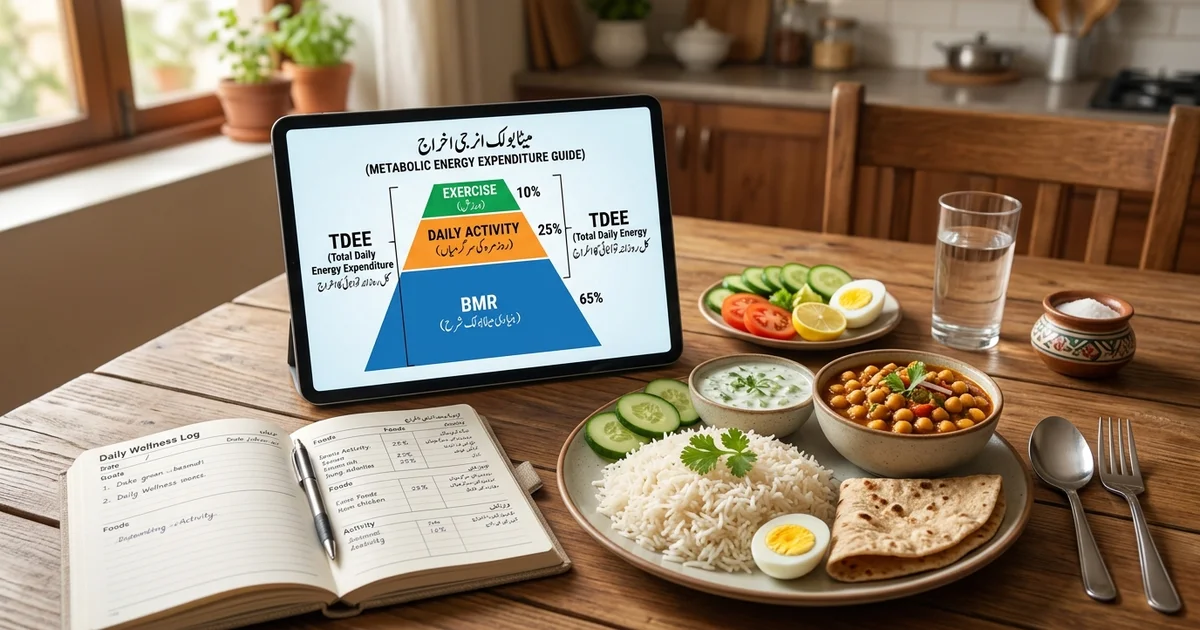
Whether your goal is weight loss, muscle hypertrophy, or maintaining metabolic health, determining your exact daily calorie requirement is the foundation of energy balance. In Pakistan, traditional diets are rich in carbohydrate-dense flatbreads (roti, naan), aromatic rice dishes (biryani, pulao), and clarified fats (ghee). Without objective calorie tracking, it is remarkably easy to exceed daily energy needs.
Our free BMR & Calorie Calculator Pakistan uses the clinically validated Mifflin-St Jeor equation to compute your Basal Metabolic Rate and Total Daily Energy Expenditure instantly.
Distinguishing BMR from TDEE
Understanding metabolic calculations requires distinguishing between two core clinical metrics:
- Basal Metabolic Rate (BMR): The energy expenditure of your body at rest in a thermo-neutral environment. BMR accounts for 60% to 75% of total daily energy expenditure, fueling involuntary cardiac contractions, lung ventilation, renal filtration, and cellular protein synthesis.
- Total Daily Energy Expenditure (TDEE): The total number of calories burned in 24 hours. TDEE combines BMR with the thermic effect of food (digestion) and physical exertion (walking, work activities, and structured exercise).
The Mifflin-St Jeor Mathematical Formula
Published in 1990 by Mifflin et al., this formula remains the gold standard in clinical dietetics due to its high predictive accuracy:
Male Formula: BMR = (10 × W) + (6.25 × H) - (5 × A) + 5
Female Formula: BMR = (10 × W) + (6.25 × H) - (5 × A) - 161
Where W = Weight in kg, H = Height in cm, and A = Age in years.
Physical Activity Multipliers
To convert BMR into actionable TDEE, apply the physical activity multiplier corresponding to your lifestyle:
| Activity Tier | Description | Multiplier |
|---|---|---|
| Sedentary | Desk job, minimal daily walking, no structured exercise | 1.200 |
| Lightly Active | Light exercise or brisk walking 1 to 3 days per week | 1.375 |
| Moderately Active | Moderate workout sessions 3 to 5 days per week | 1.550 |
| Very Active | Intense physical exercise or sports 6 to 7 days per week | 1.725 |
| Super Active | Heavy manual physical labor job plus twice daily training | 1.900 |
Practical Calculation Example: Pakistani Office Worker
Consider Tariq, a 32-year-old corporate accountant residing in Lahore. He weighs 80 kg, stands 175 cm tall (5'9"), and attends a gym 3 times per week (Moderately Active).
- Step 1 (BMR Calculation): (10 × 80) + (6.25 × 175) - (5 × 32) + 5 = 800 + 1,093.75 - 160 + 5 = 1,739 calories/day.
- Step 2 (TDEE Calculation): 1,739 × 1.55 = 2,695 calories/day for maintenance.
- Step 3 (Fat Loss Deficit): 2,695 - 500 = 2,195 calories/day to lose ~0.5 kg of body fat per week.
Pakistani Dietary Context & Calorie Tracking
A major challenge in Pakistani nutrition is accurately estimating domestic meal portions. Below is a sample 2,100-calorie daily desi menu structure designed for steady fat loss:
- Breakfast (~520 cal): 2 whole boiled eggs, 1 medium whole-wheat roti (80g dough), and 1 cup of doodh patti tea with low sugar.
- Lunch (~650 cal): 1.5 cups boiled basmati rice (220g), 150g chicken curry (salan) prepared with measured oil, and fresh cucumber/tomato salad.
- Afternoon Snack (~220 cal): 1 medium guava or apple alongside 12 raw almonds.
- Dinner (~580 cal): 2 medium whole-wheat rotis, 1 bowl of daal (chana or moong), and mixed vegetable curry.
- Night Routine (~130 cal): 1 small glass (200ml) of warm low-fat milk.
Critical Dietary Pitfalls in Pakistan
When tracking daily energy intake, avoid these four common dietary traps:
- Unmeasured Cooking Oil & Ghee: Cooking oil contains 120 calories per tablespoon (14g). Cooking salan with unmeasured oil can add 300–500 uncounted calories to a family dish.
- Liquid Sugars in Beverages: Commercial sodas, packaged juices, and sweetened chai contribute empty calories that fail to induce satiety.
- Eating Below BMR: Severe starvation diets (e.g., eating 1,000 calories when BMR is 1,600) cause severe muscle loss, thyroid slowing, and eventual weight rebound.
- Ignoring Portions of Flatbreads: A thin home-cooked roti contains ~120 calories, whereas a restaurant tandoori naan or paratha can exceed 350–450 calories.
Explore Sibling Health & Fitness Calculators
Optimize your fitness journey using our full suite of health utilities. Calculate your daily requirements with our BMR & Calorie Calculator Pakistan, and explore these related guides:
- BMI Calculator Pakistan Guide — Evaluate your overall Body Mass Index against South Asian risk thresholds.
- Ideal Weight Calculator Guide — Learn target body weight benchmarks based on clinical height formulas.
Frequently Asked Questions
How many calories should I consume to lose 1 kg per week in Pakistan?
Losing 1 kg of fat per week requires a cumulative deficit of 7,700 calories, or roughly 1,000 calories per day below your TDEE. However, most individuals should aim for a safer deficit of 500 calories per day (0.5 kg loss per week) to protect lean muscle mass.
Is the Mifflin-St Jeor formula accurate for South Asian populations?
Yes, Mifflin-St Jeor is the preferred clinical standard for predicting metabolic baseline in adults. While South Asians may possess subtle body composition differences, it provides a highly reliable starting point when combined with consistent weekly weight tracking.
Why should you never eat below your Basal Metabolic Rate (BMR)?
Consuming fewer calories than your BMR deprives vital organs of baseline energy, triggering metabolic slowing, muscle atrophy, fatigue, and hormonal disruption. Calorie deficits should always be subtracted from TDEE while remaining above BMR.
Last Updated: August 11, 2026 | Author: Abaid Awan (Financial & Health Systems Architect) | Reading time: 8 min | Sources: Mifflin-St Jeor equation, WHO Dietary Energy Guidelines | Contact: contact@pakcalchub.com
Abaid Awan
Developer & Editor, PakCalcHubDeveloper & Editor of PakCalcHub. Specialized in microsecond client-side calculation models and statutory FBR/NEPRA/SBP formula verification.
Calculate BMR & Calorie Calculator Instantly
Zero signups. Microsecond client-side calculations based on latest Pakistan statutory rules.
Salary Tax Calculator Pakistan 2026-27 & 2025-26
FBR salaried tax slabs 2025-26 & 2026-27 with return filing
Use CalculatorRecommended Knowledge Guides
Explore verified Pakistan tax, utility, property, and financial guides.