BMI Calculator Pakistan - Ideal Chart for Men & Women
Calculate BMI for Pakistanis using WHO and Asian standards. Learn ideal BMI range 18.5-23 for South Asians, categories, formula, and health risks.
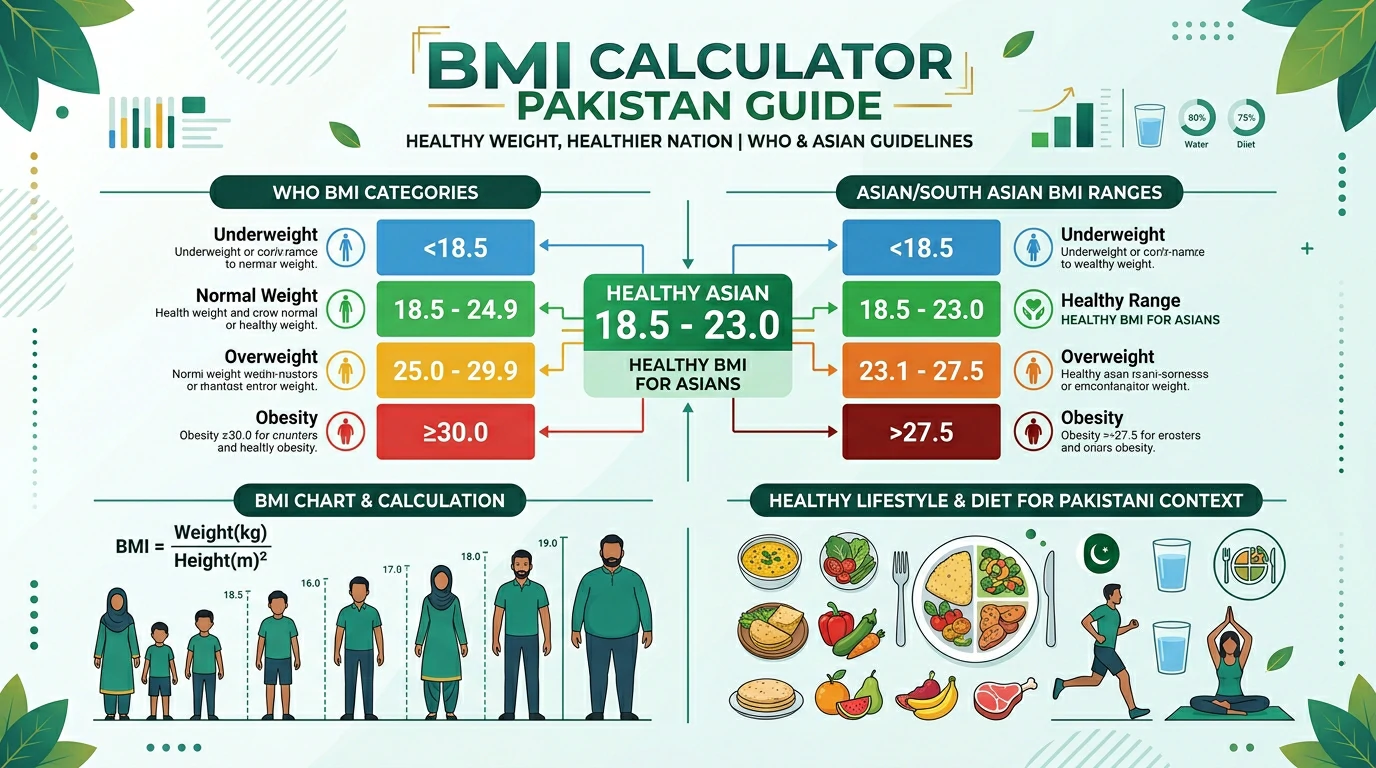
Body Mass Index (BMI) is the simplest screening tool to check whether your weight is healthy relative to your height. In Pakistan, where type-2 diabetes, hypertension, and cardiovascular diseases affect a large percentage of adults, tracking your BMI provides a vital early indicator for metabolic health. Our BMI Calculator Pakistan allows you to evaluate your numbers in kg/cm or feet/inches instantly.
What is BMI?
BMI (Body Mass Index) is an international statistical ratio calculated by dividing a person's body weight in kilograms by the square of their height in meters. Medical professionals and public health agencies use BMI as a non-invasive screening metric to evaluate population-level weight categories.
BMI Formula & Worked Example
BMI = Weight (kg) ÷ [Height (m)]²
Step-by-step example for a Pakistani adult weighing 70 kg at 5 ft 8 in (1.73 m):
- Square the height in meters: 1.73 × 1.73 = 2.9929 m²
- Divide weight by height squared: 70 ÷ 2.9929 = 23.39
- Result: A BMI of 23.4 places this individual in the normal range under standard WHO guidelines, but right at the boundary for South Asian health targets.
Standard WHO BMI Categories
| BMI Range (WHO) | Classification | Health Risk Level |
|---|---|---|
| Below 18.5 | Underweight | Nutritional deficiency, lower immunity |
| 18.5 – 24.9 | Normal Weight | Lowest overall disease risk |
| 25.0 – 29.9 | Overweight | Elevated risk for diabetes and hypertension |
| 30.0 and above | Obese | High risk for cardiovascular complications |
Why South Asians Require a Lower BMI Cutoff (18.5 – 23.0)
Clinical studies published by WHO and the International Diabetes Federation confirm that South Asians (including Pakistanis) tend to accumulate a higher percentage of abdominal visceral body fat at lower body weights compared to Caucasian populations. Consequently, metabolic syndrome and insulin resistance occur at lower BMI thresholds in Pakistan.
- Underweight: Below 18.5
- Asian Normal Range: 18.5 – 23.0
- Asian Overweight: 23.0 – 27.5
- Asian Obese: 27.5 and above
Pakistani Height-to-Weight Reference Table
The table below highlights healthy weight targets comparing standard WHO limits with South Asian regional health recommendations:
| Height | WHO Normal Weight (18.5–24.9) | South Asian Health Target (18.5–23.0) |
|---|---|---|
| 5 ft 3 in (160 cm) | 47.4 – 63.7 kg | 47.4 – 58.9 kg |
| 5 ft 6 in (168 cm) | 52.2 – 70.3 kg | 52.2 – 64.9 kg |
| 5 ft 8 in (173 cm) | 55.4 – 74.5 kg | 55.4 – 68.8 kg |
| 5 ft 10 in (178 cm) | 58.6 – 78.9 kg | 58.6 – 72.9 kg |
| 6 ft 0 in (183 cm) | 61.9 – 83.4 kg | 61.9 – 77.0 kg |
Limitations of BMI
While BMI is an excellent general screening index, it has physiological limitations:
- Does not distinguish muscle from fat: Muscular individuals or bodybuilders may register as overweight or obese despite having minimal body fat.
- Does not measure fat distribution: Visceral belly fat carries higher risk than subcutaneous leg fat, which BMI cannot detect.
- Age variations: Elderly adults naturally lose lean muscle mass, meaning a normal BMI may mask sarcopenic obesity.
Use Our Sibling Health Calculators
Evaluate your complete health profile using our specialized Pakistani health calculators:
- BMI Calculator Pakistan — Compute your exact body mass index and status.
- BMR & Calorie Calculator Guide — Calculate your Basal Metabolic Rate and TDEE daily calorie targets.
- Ideal Weight Calculator Guide — Determine target body weight using established clinical formulas (Devine, Robinson, Miller).
Frequently Asked Questions
What is considered a healthy BMI for adults in Pakistan?
While standard global WHO criteria define normal weight as 18.5 to 24.9, clinical health guidelines for South Asian adults recommend maintaining a target BMI between 18.5 and 23.0 to manage metabolic health risks.
Why is the Asian BMI cutoff lower for Pakistanis?
South Asian populations genetically tend to carry a higher ratio of visceral abdominal body fat at lower total weights, leading to increased risk for type-2 diabetes and hypertension at lower BMIs.
Can BMI overestimate body fat in muscular people?
Yes. Because BMI evaluates total body weight relative to height, highly muscular athletes or weightlifters may test in the overweight range despite having low body fat percentage.
How often should I monitor my BMI?
Checking your BMI once every month during weight loss or gain programs, or every 3 to 6 months for ongoing health maintenance, is recommended.
Last Updated: August 11, 2026 | Author: Abaid Awan | Reading time: 6 min | Sources: WHO Obesity Guidelines, South Asian BMI Consultation | Contact: contact@pakcalchub.com
Abaid Awan
Developer & Editor, PakCalcHubDeveloper & Editor of PakCalcHub. Specialized in microsecond client-side calculation models and statutory FBR/NEPRA/SBP formula verification.
Calculate BMI Calculator Instantly
Zero signups. Microsecond client-side calculations based on latest Pakistan statutory rules.
Salary Tax Calculator Pakistan 2026-27 & 2025-26
FBR salaried tax slabs 2025-26 & 2026-27 with return filing
Use CalculatorRecommended Knowledge Guides
Explore verified Pakistan tax, utility, property, and financial guides.