Ideal Weight Calculator Pakistan Guide - Height & Weight Chart
Complete guide to ideal body weight for Pakistani men and women by height. Explains Devine, Robinson, and BMI healthy weight formulas with height charts.
Quick Summary: Ideal Weight in Pakistan
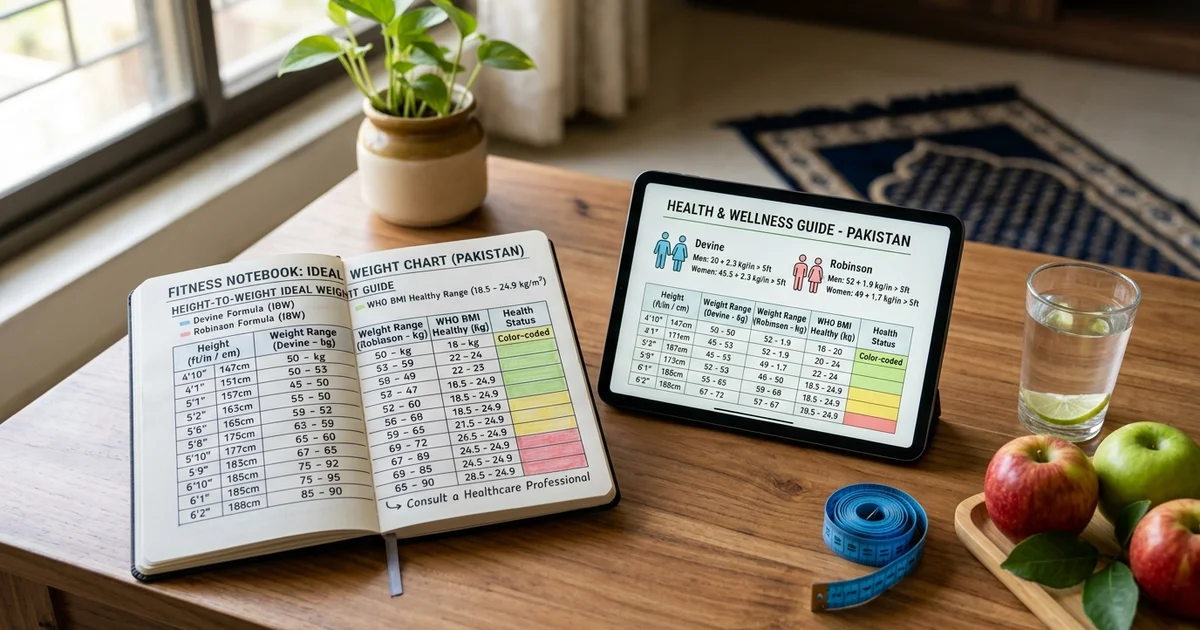
Ideal Body Weight (IBW) in Pakistan is calculated using height and gender via clinical equations like the Devine formula (50 kg for men, 45.5 kg for women + 2.3 kg per inch over 5ft) and the WHO Healthy BMI Range (18.5–24.9 kg/m²). For example, a 5'8" (173 cm) Pakistani adult has an estimated IBW of ~68 kg with a healthy weight range of 55–75 kg.
Determining your ideal body weight is a cornerstone of long-term health management, nutrition planning, and preventive care. In Pakistan, where cardiovascular disease and type-2 diabetes are increasingly prevalent, understanding where your weight stands relative to medical benchmarks helps guide realistic fitness goals. Our interactive Ideal Weight Calculator Pakistan calculates target weights using established clinical formulas alongside healthy Body Mass Index (BMI) ranges.
Evolution of Ideal Weight Formulas
The concept of Ideal Body Weight (IBW) originated in medical pharmacology rather than aesthetic fitness. Doctors needed a reliable method to calculate proper medication dosages for drugs that do not clear through fat tissue (such as anesthesia agents and water-soluble therapeutics).
Over the decades, four primary mathematical formulas emerged:
- Devine Formula (1974): Developed by Dr. B.J. Devine, this is the gold standard used in clinical settings worldwide. It sets a baseline weight for a 5-foot (152 cm) height and adds a fixed increment for every additional inch.
- Robinson Formula (1983): Created as a empirical modification of the Devine equation, adjusting the baseline and per-inch multipliers to better match modern population height distribution data.
- Miller Formula (1983): Proposed around the same time as Robinson, placing slightly lower weight values on height increments for taller individuals.
- Hamwi Formula (1964): One of the earliest rule-of-thumb formulas used in clinical dietetics (50 kg + 6 lbs per inch for men; 45 kg + 5 lbs per inch for women).
Step-by-Step Mathematical Formulas
1. Devine Formula
- Men: 50 kg + 2.3 kg × (Height in inches - 60)
- Women: 45.5 kg + 2.3 kg × (Height in inches - 60)
2. Robinson Formula
- Men: 52 kg + 1.9 kg × (Height in inches - 60)
- Women: 49 kg + 1.7 kg × (Height in inches - 60)
3. WHO Healthy BMI Range Method
Unlike fixed single-number formulas, the WHO method uses a healthy Body Mass Index interval (18.5 to 24.9 kg/m²):
- Minimum Healthy Weight: 18.5 × (Height in meters)²
- Maximum Healthy Weight: 24.9 × (Height in meters)²
- Ideal Mid-Point Target (BMI 22.0): 22.0 × (Height in meters)²
Comprehensive Ideal Weight Chart for Pakistan
The following reference table outlines calculated ideal weights and healthy ranges for common Pakistani adult heights:
| Height (ft / in & cm) | Devine Male | Devine Female | BMI Healthy Range (18.5–24.9) |
|---|---|---|---|
| 5 ft 0 in (152 cm) | 50.0 kg | 45.5 kg | 42.8 - 57.5 kg |
| 5 ft 3 in (160 cm) | 56.9 kg | 52.4 kg | 47.4 - 63.7 kg |
| 5 ft 5 in (165 cm) | 61.5 kg | 57.0 kg | 50.4 - 67.8 kg |
| 5 ft 8 in (173 cm) | 68.4 kg | 63.9 kg | 55.4 - 74.5 kg |
| 5 ft 10 in (178 cm) | 73.0 kg | 68.5 kg | 58.6 - 78.9 kg |
| 6 ft 0 in (183 cm) | 77.6 kg | 73.1 kg | 62.0 - 83.4 kg |
Detailed Worked Example: 5 ft 8 in Male
Consider a Pakistani male who is 5 ft 8 in (173 cm) tall:
- Height in inches above 5 ft: 68 inches - 60 inches = 8 inches.
- Devine Calculation: 50 kg + (2.3 kg × 8) = 50 + 18.4 = 68.4 kg.
- Robinson Calculation: 52 kg + (1.9 kg × 8) = 52 + 15.2 = 67.2 kg.
- BMI Healthy Range (1.73m): 18.5 × 1.73² to 24.9 × 1.73² = 55.4 kg to 74.5 kg.
South Asian Frame Size & Body Composition Considerations
While formula calculations provide clean mathematical benchmarks, physiological realities require careful interpretation in South Asia:
- Visceral Adiposity: Epidemiological studies show that South Asians tend to carry a higher percentage of abdominal visceral fat at lower body weights compared to Western populations.
- Frame Size Adjustments: Individuals with small wrist circumferences (under 6.25 inches for men) should target the lower half of the BMI healthy range, whereas broad-framed or highly muscular individuals should aim for the upper half.
- Sarcopenic Obesity Prevention: Maintaining adequate protein intake and resistance exercise is essential so that weight loss targets reduce fat rather than lean muscle mass.
Common Errors in Ideal Weight Management
- Obsessing Over a Single Number: Health is a range, not a single exact digit on a bathroom scale.
- Ignoring Muscle Mass: Athletes may weigh more than their calculated IBW while possessing low body fat.
- Extreme Crash Dieting: Rapid caloric restriction causes muscle loss, slowing Basal Metabolic Rate (BMR).
Explore Free Health & Fitness Tools
Assess your health profile using our suite of interactive calculators:
- Ideal Weight Calculator Pakistan — Compute Devine, Robinson, and BMI healthy targets for your exact height.
- BMI Calculator Pakistan Guide — Check if your current weight meets WHO and South Asian BMI health standards.
- BMR & Calorie Calculator Guide — Learn how many daily calories (TDEE) you need to reach your target weight safely.
Frequently Asked Questions
What is the ideal weight for a 5 ft 4 in Pakistani woman?
For a 5 ft 4 in (163 cm) Pakistani woman, the Devine formula estimates an ideal weight of ~54.7 kg, the Robinson formula gives ~55.8 kg, and the standard healthy WHO BMI range (18.5–24.9) spans 49.2 kg to 66.2 kg.
Is ideal body weight accurate for muscular or athletic individuals?
No. Traditional ideal weight formulas rely exclusively on height and gender, without accounting for lean muscle mass vs. body fat ratio. Muscular athletes often exceed calculated IBW limits while maintaining excellent metabolic health.
Why do South Asian health guidelines recommend lower target weights?
Medical research demonstrates that South Asians, including Pakistanis, exhibit higher visceral fat percentages and greater metabolic risk at lower BMI thresholds. Clinical guidelines suggest aiming for a mid-range target (BMI 21–23) for optimal cardiovascular protection.
Last Updated: August 11, 2026 | Author: Abaid Awan | Reading time: 7 min | Sources: WHO BMI Guidelines, Devine BJ (1974), Robinson JD (1983) | Contact: contact@pakcalchub.com
Abaid Awan
Developer & Editor, PakCalcHubDeveloper & Editor of PakCalcHub. Specialized in microsecond client-side calculation models and statutory FBR/NEPRA/SBP formula verification.
Calculate Ideal Weight Calculator Instantly
Zero signups. Microsecond client-side calculations based on latest Pakistan statutory rules.
Salary Tax Calculator Pakistan 2026-27 & 2025-26
FBR salaried tax slabs 2025-26 & 2026-27 with return filing
Use CalculatorRecommended Knowledge Guides
Explore verified Pakistan tax, utility, property, and financial guides.