How to Calculate Zakat in Pakistan 2026 - Nisab, Gold, Silver & Banking Guide
Complete 2026 guide on Zakat calculation in Pakistan. Understand 7.5 Tola Gold & 52.5 Tola Silver Nisab, SBP bank deductions, FBR Section 60 tax rebates, and 2.5% formula.
AI Summary: Core Zakat Framework in Pakistan
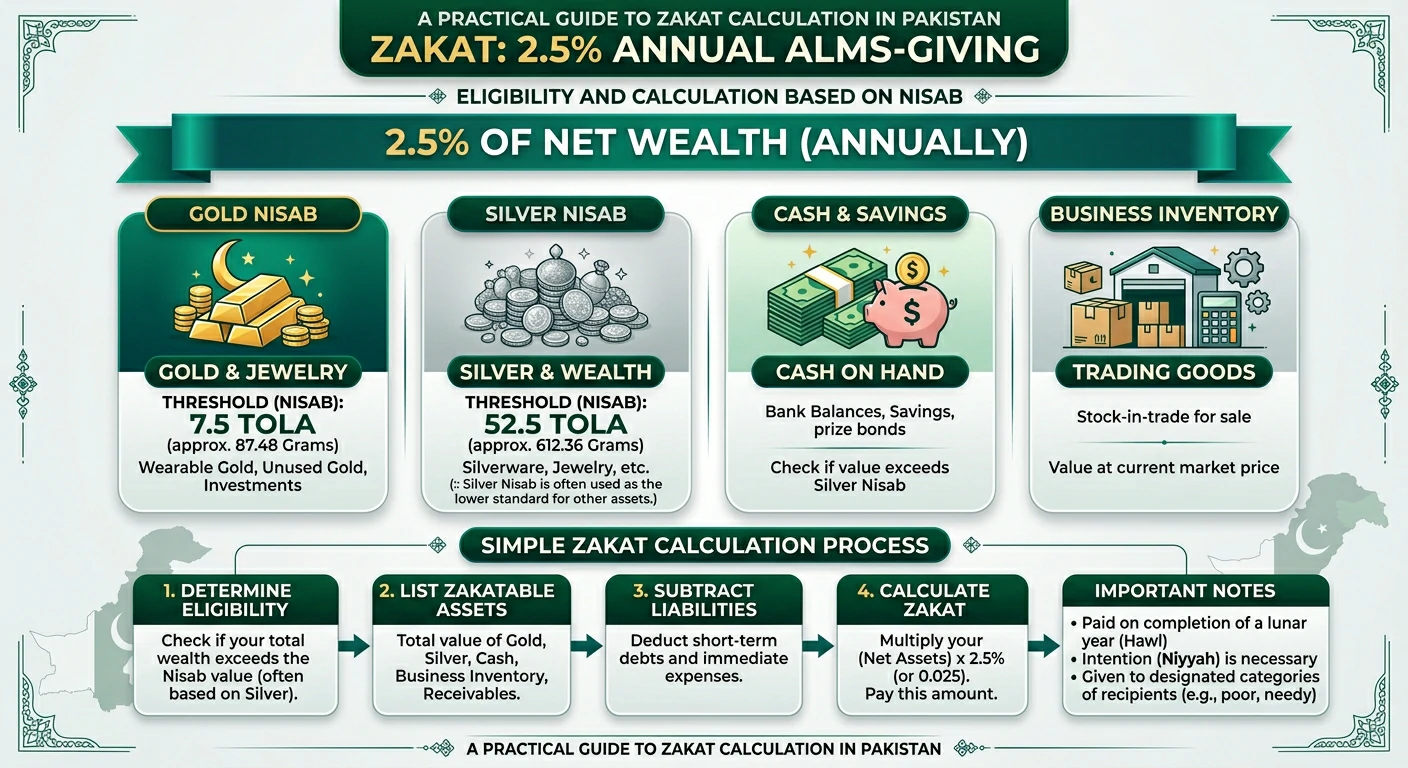
Every Ramadan, families across Pakistan — from Sargodha to Karachi — evaluate their financial assets to calculate Zakat. Questions frequently arise regarding the distinction between Gold Nisab and Silver Nisab, how to value mixed assets (cash in Meezan or HBL, gold jewelry, prize bonds, and stock investments), and how the State Bank of Pakistan handles automatic deductions on savings accounts.
This comprehensive guide explains the exact formula, juristic perspectives, banking rules, and FBR tax deduction privileges in accordance with official notifications and classical Islamic jurisprudence.
1. What is Nisab? Understanding Gold vs Silver Benchmarks
Nisab is the minimum threshold of wealth an individual must possess before Zakat becomes obligatory. If your net wealth is below Nisab, no Zakat is due. If your net wealth meets or exceeds Nisab and is retained for one full lunar year (354 days), Zakat is calculated at 2.5%.
Gold Nisab Benchmark
7.5 Tola (87.48 Grams)
At a market rate of ~Rs 260,000 per tola (24k), Gold Nisab equals approximately Rs 1,950,000.
Silver Nisab Benchmark (SBP Official)
52.5 Tola (612.36 Grams)
At a market rate of ~Rs 3,200 per tola, Silver Nisab equals approximately Rs 168,000.
Why Do Two Nisab Standards Exist?
During the era of the Prophet Muhammad (ﷺ), 7.5 tolas of gold and 52.5 tolas of silver possessed equivalent monetary purchasing power. In modern global financial markets, silver has become significantly cheaper relative to gold.
Scholarly Consensus & SBP Practice: Most Islamic scholars in Pakistan — as well as the State Bank of Pakistan (SBP) under the Zakat and Ushr Ordinance, 1980 — utilize the Silver Nisab standard. Because the silver threshold is lower (~Rs 168,000), it allows more individuals with moderate savings to participate in Zakat, maximizing financial support for widow pensions, healthcare funds, and impoverished communities.
Note on Differing Views: Some contemporary scholars suggest that individuals whose wealth consists strictly and exclusively of gold savings may assess liability against the Gold Nisab threshold. For mixed assets (cash + gold + silver), adopting Silver Nisab is widely recommended for religious safety.
2. Universal 2.5% Zakat Formula
Zakat calculation follows a clean, single mathematical equation:
3. Worked Example — Real Pakistani Household
Let's examine a realistic calculation for a family residing in Lahore:
- Cash & Bank Accounts: Rs 250,000 in savings/checking accounts (Meezan Bank / HBL)
- Gold Jewelry: 2 tolas of 22k gold jewelry valued at Rs 480,000 (To evaluate precise gold karat values, check our Gold Price Calculator Pakistan)
- Silver Ornaments: Value Rs 25,000
- Business Inventory: Shop stock goods valued at market resale price Rs 150,000
- Short-Term Debts Due: Vendor supply bill due next week Rs 105,000
Step 1 (Gross Assets): Rs 250,000 + Rs 480,000 + Rs 25,000 + Rs 150,000 = Rs 905,000
Step 2 (Net Zakatable Wealth): Rs 905,000 − Rs 105,000 = Rs 800,000
Step 3 (Nisab Verification): Net Wealth (Rs 800,000) exceeds Silver Nisab (~Rs 168,000). Zakat is obligatory.
Step 4 (Final Zakat): Rs 800,000 × 2.5% = Rs 20,000
When Should You Use This Calculator?
The Zakat Calculator Pakistan is designed to help Muslims in Pakistan fulfill this pillar of Islam with accuracy. Use it:
- Ramadan Asset Auditing: To compute cumulative personal wealth across cash, bank balances, gold, mutual funds, and business stock at the end of your Zakat cycle.
- Mixed-Asset Valuations: When you hold combinations of gold jewelry and liquid bank deposits, helping you check whether you exceed the Silver Nisab threshold.
- Deduction Balancing: To calculate permissible liabilities (short-term loans, utility bills, business supplier invoices) that should be subtracted before finding net Zakatable wealth.
Practical Asset Classification for Zakat in Pakistan
To avoid errors, it is important to categorize your possessions correctly. Traditional Islamic jurisprudence divides assets into two primary categories:
| Asset Category | Examples in Pakistan | Zakat Status | Valuation Method |
|---|---|---|---|
| Personal-Use Assets | Residential house, personal car, household furniture, clothing, laptop. | 100% EXEMPT | No valuation needed. Zero Zakat due on personal utility items. |
| Liquid Financial Savings | Meezan or HBL bank savings, cash at home, prize bonds, digital wallets (Nayapay). | ZAKATABLE | Calculate 100% of current cash balance at the end of the Zakat anniversary. |
| Investment Real Estate | Plots in DHA or Bahria Town held for resale capital gains. | ZAKATABLE | Value at current market selling price on your Zakat calculation day. |
| Rental Properties | A house or commercial plaza let out to tenants. | PARTIALLY EXEMPT | No Zakat on the land/building value; pay 2.5% only on accumulated rental cash income. |
| Business Stock & Inventory | Retail shop inventory, warehouse raw materials, unsold commercial goods. | ZAKATABLE | Value inventory at current wholesale market cost, not retail selling price. |
⚠️ Common Zakat Calculation Mistakes in Pakistan
- Paying Zakat on Exempt Personal Assets: Do not pay Zakat on your primary residence, personal vehicle, or tools of trade, even if their market value is high.
- Forgetting to Deduct Immediate Liabilities: Failing to subtract outstanding business invoices or immediate utility bills leads to overpaying.
- Ignoring Mixed-Asset Conversion Rules: If you hold Rs 50,000 cash and Rs 150,000 worth of gold, you meet the Silver Nisab threshold and must pay Zakat on the entire cumulative sum.
- Letting Banks Double-Deduct on Savings: SBP automatically deducts Zakat from savings accounts. If you have already paid manually, submit a CZ-08 exemption form beforehand to avoid double deductions.
📋 What to Do After Calculating Your Zakat
- Identify Eligible Recipients: Make sure recipients fit the 8 Quranic categories. Paying Zakat to immediate dependents (parents, children, spouse) is invalid.
- Verify Gold and Silver Karat Weights: Double-check actual jewelry weights. For gold, use our Gold Price Calculator to find precise pure metal values.
- Set Your Annual Lunar Anniversary (Hawl): Keep a record of the Hijri date when your savings first exceeded Nisab. This establishes your official yearly Zakat deadline.
4. State Bank of Pakistan (SBP) & Banking Rules
Under the Zakat & Ushr Ordinance 1980, commercial banks in Pakistan automatically deduct 2.5% Zakat from Savings Accounts, Profit & Loss Sharing (PLS) accounts, and Term Deposit Receipts (TDRs) on the 1st of Ramadan if account balances exceed the SBP notified Nisab threshold.
- Current Accounts Exemption: Standard Current Accounts (PKR or Foreign Currency) are legally exempt from automatic bank deduction.
- CZ-08 Declaration Form: Account holders who wish to distribute Zakat independently (or belong to Fiqh Ja'faria / exempt categories) can submit an attested CZ-08 Form (Zakat Exemption Affidavit) on stamp paper to their bank branch prior to Ramadan.
- CZ-50 Certificate: Banks issue a CZ-50 Zakat Deduction Certificate showing the exact amount deducted, which can be used as proof for tax rebates.
5. Claiming FBR Income Tax Deductions (Section 60)
Did you know Zakat paid can lower your official tax bill in Pakistan? Under Section 60 of the Income Tax Ordinance, 2001, any Zakat paid under the Zakat and Ushr Ordinance or donated to government-approved welfare funds is eligible for a 100% direct allowance against your total taxable income. You can upload bank CZ-50 deduction certificates or official charitable receipts when filing your annual Iris FBR return. Learn more in our Salary Tax Slabs & Calculator Guide.
6. Who Can Receive Zakat? (Eligible Categories / Asnaf-e-Zakat)
According to Surah At-Tawbah (Holy Qur'an 9:60), Zakat funds must be distributed strictly among eight specific categories of eligible recipients:
- Al-Fuqara (The Poor): Individuals without wealth or income sufficient to meet basic daily survival needs.
- Al-Masakin (The Destitute): Extremely needy individuals who possess no property or financial means whatsoever.
- Al-Amilina 'Alayha (Zakat Collectors): Authorized administrators responsible for collecting and distributing Zakat funds.
- Al-Mu'allafatu Qulubuhum (Reconciled Hearts): New Muslims or those in need of financial encouragement and social support.
- Fir-Riqab (Freeing Captives): Financial assistance to free individuals from wrongful detention or debt bondage.
- Al-Gharimin (Insolvent Debtors): People burdened by overwhelming debts contracted for lawful living expenses who cannot repay their creditors.
- Fi Sabilillah (In the Cause of Allah): Funding community welfare, Islamic education, healthcare facilities (e.g., Shaukat Khanum, Edhi Foundation), and humanitarian relief.
- Ibn Al-Sabil (Stranded Travelers): Travelers or refugees stranded away from home without access to funds.
7. Zakatable vs. Exempt Assets Matrix
| Asset Category | ✅ Zakatable (2.5%) | ❌ Strictly Exempt |
|---|---|---|
| Cash & Liquidity | Bank savings, JazzCash, EasyPaisa, foreign cash, prize bonds | House security rental deposits, advance tax withheld |
| Precious Metals | Gold & Silver coins, bars, bullion, and jewelry | Artificial costume jewelry, diamonds, rubies, pearls |
| Real Estate | Plots & houses purchased specifically for resale trading | Personal living house, agricultural land for cultivation |
| Business & Vehicles | Commercial shop inventory at resale market price | Personal family car, factory machinery, tools of trade |
8. Related Tools & Financial Calculators
Perform instant, accurate calculations with our suite of Pakistani financial tools:
- Zakat Calculator Pakistan Tool — Interactive wealth breakdown calculator with customizable Nisab thresholds and downloadable Zakat statements.
- Gold Price Calculator Pakistan — Real-time valuation for 24k, 22k, and 21k gold tolas and grams.
- Salary Tax Calculator Pakistan — Calculate FBR Section 60 tax rebates on Zakat paid.
- Gold Price & Tola Conversion Guide — Understanding gold purity standards in Pakistan markets.
Frequently Asked Questions
Q: What is the Nisab threshold for 2026 in Pakistan?
A: Per SBP guidelines, Silver Nisab (52.5 tolas / 612.36g) is approximately Rs 168,000. Gold Nisab (7.5 tolas / 87.48g) is approximately Rs 1,950,000.
Q: How do I submit CZ-08 form to my bank?
A: Obtain a CZ-08 Zakat exemption form from an authorized stamp vendor, get it notarized, and submit it to your bank branch before 1st Ramadan.
Q: Is Zakat due on personal gold jewelry?
A: Under Hanafi jurisprudence (widely followed in Pakistan), Zakat is due on all gold and silver jewelry regardless of whether it is worn or stored. Under Shafi'i and Ja'fari jurisprudence, customary personal ornament jewelry is exempt. Consult your local scholar for specific personal guidance.
Q: Is Zakat calculated before or after debts?
A: Zakat is calculated on Net Wealth after deducting short-term immediate liabilities due now.
Q: Is Zakat payable on business inventory?
A: Yes, shop inventory intended for trade is zakatable at 2.5% of its wholesale/resale market value.
Q: Can I calculate Zakat in Pakistani Rupees?
A: Yes! Use our Zakat Calculator Pakistan to enter all values directly in PKR.
Last Updated: July 25, 2026 | Author: Abaid Awan | Reading time: 8 min | Official Sources: State Bank of Pakistan Zakat Notification, FBR Income Tax Ordinance 2001 Section 60 | Contact: contact@pakcalchub.com
Disclaimer: This guide provides educational financial information according to Pakistani laws and general Islamic consensus. For specialized juristic fatwas or complex inheritance assets, consult a qualified Islamic scholar.
Abaid Awan
Developer & Editor, PakCalcHubDeveloper & Editor of PakCalcHub. Specialized in microsecond client-side calculation models and statutory FBR/NEPRA/SBP formula verification.
Calculate Zakat Calculator Instantly
Zero signups. Microsecond client-side calculations based on latest Pakistan statutory rules.
Salary Tax Calculator Pakistan 2026-27 & 2025-26
FBR salaried tax slabs 2025-26 & 2026-27 with return filing
Use CalculatorGold Price Calculator Pakistan Live
Live Tola, gram, 24k/22k/21k from internet
Use CalculatorRecommended Knowledge Guides
Explore verified Pakistan tax, utility, property, and financial guides.