CNIC Checker Pakistan - 13-Digit Format Validation Guide
Validate Pakistani CNIC format: 13 digits XXXXX-XXXXXXX-X. Learn province/district codes, gender check, and privacy-safe validation.
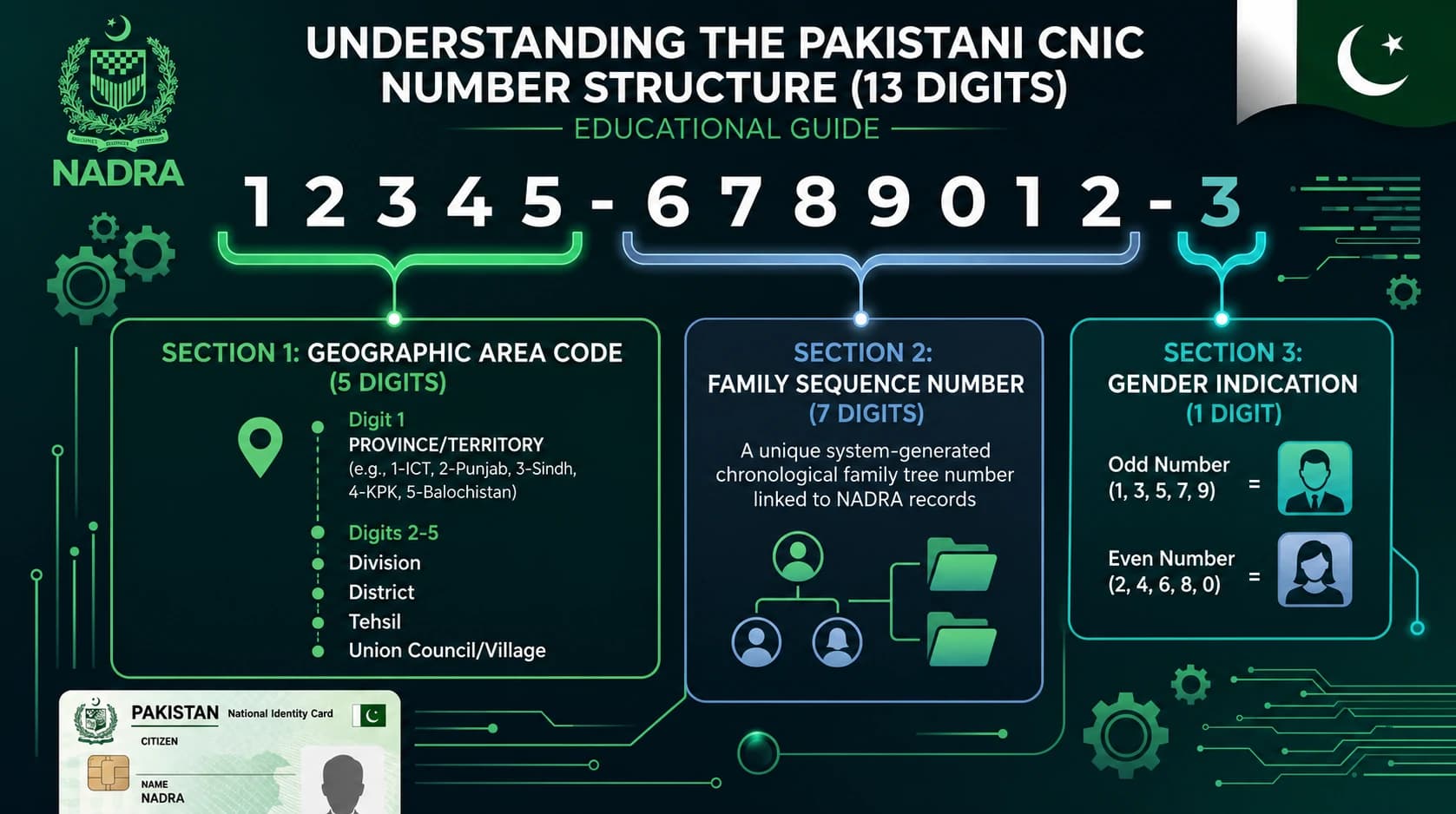
The Computerized National Identity Card (CNIC) is the primary legal identity document issued to Pakistani citizens aged 18 and above by the National Database and Registration Authority (NADRA). Every CNIC is encoded with a unique 13-digit identification number. Far from being a random sequence, this 13-digit string follows a strict, standardized administrative structure that embeds geographic origin and demographic parameters.
Understanding the architecture of a Pakistani CNIC number enables administrative staff, business operators, and citizens to verify numerical format validity, detect typographical errors, and recognize administrative regional prefixes—all while respecting strict digital privacy boundaries.
Want to check a CNIC format instantly?
Use our 100% private, client-side format validator to test 13-digit inputs and decode regional prefixes.
2. Anatomy of a 13-Digit CNIC Number
In official correspondence and identity cards, a Pakistani CNIC is formatted using the universal pattern XXXXX-XXXXXXX-X. It is divided into three distinct segments:
- First Segment (5 Digits): The Administrative Regional Code. Encodes the citizen's province, division, district, and local registration office region.
- Second Segment (7 Digits): The Family Serial Block. Represents the unique sequence assigned to the individual's family tree register within NADRA's database.
- Third Segment (1 Digit): The Gender Coding Hint. Indicates registered gender parity (odd numbers for males, even numbers for females or transgender individuals).
3. First 5 Digits: Province, Territory & Administrative Codes
The initial digit of any valid Pakistani CNIC corresponds directly to the province or administrative territory where the citizen was first registered in the national database:
| 1st Digit | Province / Administrative Region | Common District Prefix Examples |
|---|---|---|
| 1 | Khyber Pakhtunkhwa (KPK) | 17301 (Peshawar), 13101 (Abbottabad), 15601 (Swat), 11101 (Bannu) |
| 2 | FATA / Merged KP Districts | 21101 (Khyber), 21201 (Kurram), 21501 (North Waziristan) |
| 3 | Punjab | 35201 (Lahore), 33100 (Faisalabad), 37405 (Rawalpindi), 38403 (Sargodha) |
| 4 | Sindh | 42201 (Karachi East), 41302 (Hyderabad), 43201 (Larkana), 45201 (Khairpur) |
| 5 | Balochistan | 54400 (Quetta), 51101 (Kalat), 53201 (Gwadar) |
| 6 | Islamabad Capital Territory (ICT) | 61101 (Islamabad Urban/Rural) |
| 7 | Gilgit-Baltistan (GB) | 71501 (Gilgit), 71101 (Skardu) |
| 8 | Azad Jammu & Kashmir (AJK) | 82201 (Muzaffarabad), 81101 (Mirpur) |
Note: First-digit values 0 and 9 are unassigned, reserved, or invalid for standard citizen identity cards.
4. Middle 7 Digits: Family Serial Block
The middle segment consists of seven numeric digits (e.g., 1234567 in 35201-1234567-1). This block connects the individual to their family register numbers maintained in NADRA's centralized database. When siblings or children are registered under the same head of family, their middle serial numbers are assigned within linked administrative registers.
5. Final Digit: Gender Coding Hint
The 13th digit (the single digit following the second hyphen) serves as a gender parity indicator:
- Odd Digits (1, 3, 5, 7, 9): Designated for male citizens.
- Even Digits (0, 2, 4, 6, 8): Designated for female citizens or individuals registered under transgender status conventions.
Important distinction: This parity rule is a structural convention of NADRA's numbering system. It provides a visual format hint but should not be treated as a legally binding identity certificate on its own.
6. CNIC vs. NICOP vs. POC vs. Smart NIC
NADRA issues several identity document formats depending on age, residency, and citizenship status. All Pakistani national identity documents share the same 13-digit numbering format:
| Document Type | Target Eligibility | Key Feature / Format |
|---|---|---|
| CNIC | Resident Pakistani Citizens (18+) | Standard 13-digit computerized paper/laminated card. |
| Smart NIC (SNIC) | Resident Pakistani Citizens (18+) | Chip-based smart card containing encrypted biometrics. |
| NICOP | Overseas Pakistani Citizens & Dual Nationals | 13-digit card granting visa-free entry into Pakistan. |
| POC | Foreign Spouses or Ex-Pakistani Nationals | Pakistan Origin Card providing legal residency privileges. |
7. Step-by-Step CNIC Format Validation Procedure
- Verify Total Length: Ensure the raw input contains exactly 13 numerical digits.
- Check Hyphenation: Confirm placement after digit 5 and digit 12 (
XXXXX-XXXXXXX-X). - Validate First Digit: Ensure the first digit falls within the valid regional range (1 through 8).
- Confirm Gender Parity: Check whether the 13th digit matches the expected odd/even convention.
8. Privacy & Security Boundaries
Online format checkers—including PakCalcHub—operate under strict digital privacy rules:
- No NADRA Database Access: Web tools cannot query NADRA's internal servers or retrieve confidential records (such as names, photos, or home addresses).
- 100% Client-Side Execution: All numerical string checks are performed locally in your browser using JavaScript. No numbers are stored or transmitted.
- Official Identity Verification: Citizens requiring official status confirmation (e.g., voter registration or family tree verification) must use NADRA's official SMS portals (8300 or 7000) or visit an accredited NADRA registration center.
9. Common CNIC Formatting Errors & How to Fix Them
- Typing Letters or Symbols: Ensure only numeric digits (0–9) are entered.
- Missing Hyphens: Standard web forms may reject raw 13-digit strings if hyphens are required. Use an auto-masking tool to format input correctly.
- Invalid Regional Prefix: Check whether the first digit was mistakenly typed as 0 or 9.
10. Frequently Asked Questions
How many digits are in a Pakistani CNIC number?
A standard Pakistani CNIC contains exactly 13 numeric digits, universally written in the 5-7-1 hypenated pattern: XXXXX-XXXXXXX-X.
What do the first 5 digits of a CNIC represent?
The first five digits represent administrative location codes assigned by NADRA. The 1st digit indicates the province or territory, the 2nd digit represents the division, and the 3rd, 4th, and 5th digits designate the district and local administrative registration area.
How do I determine gender from a CNIC number?
Gender is coded into the 13th (final) digit of the CNIC number. Odd final digits (1, 3, 5, 7, 9) indicate male registration, while even final digits (0, 2, 4, 6, 8) indicate female or transgender registration.
Can this CNIC identifier show a person's name or address?
No. Under Pakistani privacy laws and NADRA regulations, citizen names, family trees, and home addresses are encrypted and strictly confidential. This web tool only checks number structure and decodes public administrative regional prefixes.
What is the difference between CNIC and NICOP?
A CNIC (Computerized National Identity Card) is issued to resident Pakistani citizens aged 18 and above. A NICOP (National Identity Card for Overseas Pakistanis) is issued to Pakistani citizens living, working, or studying abroad, granting visa-free entry into Pakistan.
Why does my CNIC number show as invalid on some forms?
Common reasons for validation failure include missing digits (less than 13 numbers), accidentally typing letters or spaces, using unapproved first-digit prefixes (such as 0 or 9), or including extra hyphens.
Which digit indicates the province in a CNIC?
The very first digit of the 13-digit CNIC indicates the province or administrative territory (e.g., 1 for Khyber Pakhtunkhwa, 2 for FATA, 3 for Punjab, 4 for Sindh, 5 for Balochistan, 6 for Islamabad, 7 for Gilgit-Baltistan, 8 for Azad Jammu & Kashmir).
Is it safe to type my CNIC number into this online checker?
Yes. PakCalcHub executes all format checks 100% locally inside your web browser using JavaScript. No data is sent over the internet, stored in databases, or logged on any server.
Abaid Awan
Developer & Editor, PakCalcHubDeveloper & Editor of PakCalcHub. Specialized in microsecond client-side calculation models and statutory FBR/NEPRA/SBP formula verification.
Calculate CNIC Information Checker Instantly
Zero signups. Microsecond client-side calculations based on latest Pakistan statutory rules.
Salary Tax Calculator Pakistan 2026-27 & 2025-26
FBR salaried tax slabs 2025-26 & 2026-27 with return filing
Use CalculatorRecommended Knowledge Guides
Explore verified Pakistan tax, utility, property, and financial guides.