Mileage Calculator Pakistan Guide – Car & Bike Fuel Average (km/L)
Learn how to calculate car and bike mileage in km/L and L/100km in Pakistan. Formulas, real examples, fuel efficiency standards, and tips to save petrol.
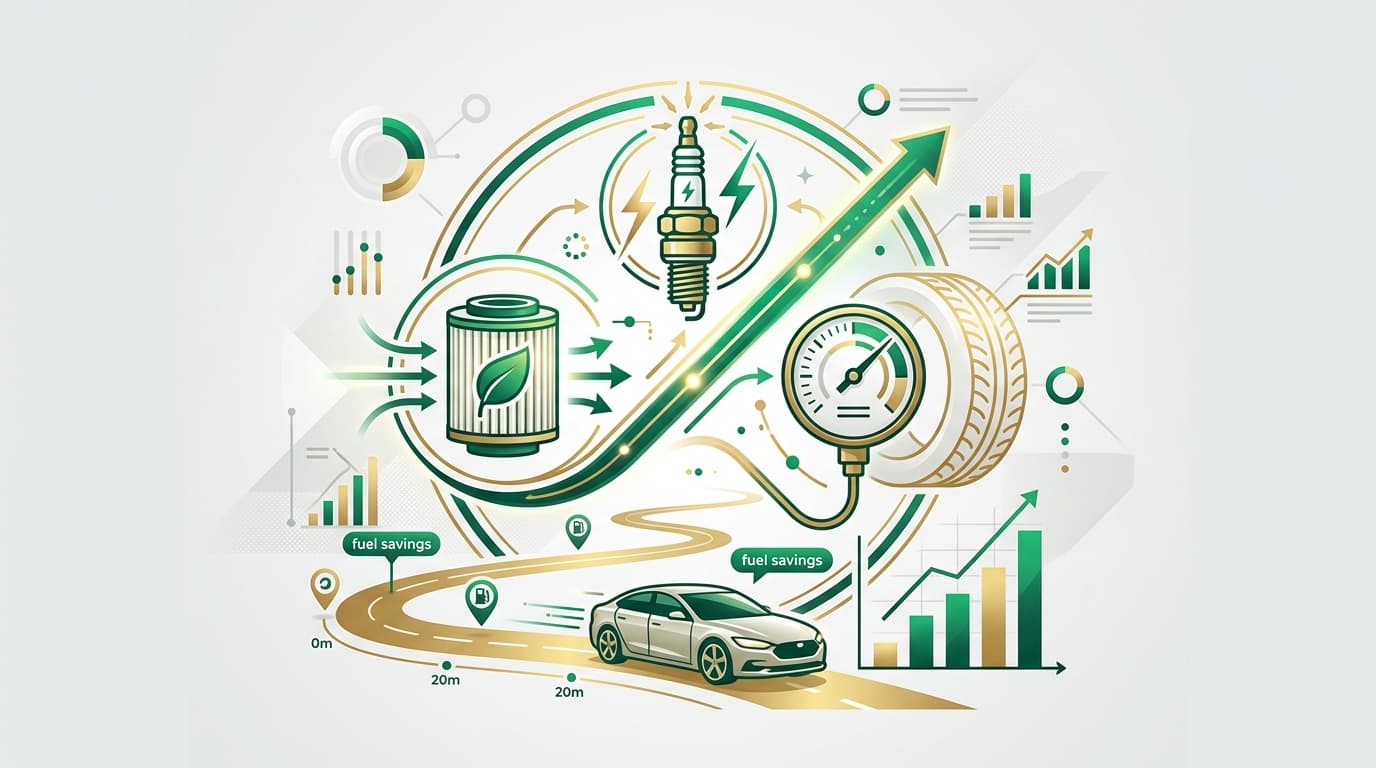
Tracking your vehicle's fuel efficiency—commonly known in Pakistan as "fuel average"—is one of the most effective mechanical health habits a driver can develop. A sudden drop in kilometers per liter (km/L) is often the earliest warning sign of engine wear, transmission slipping, or sensor malfunction. Using our interactive Mileage Calculator Pakistan, you can log fuel refills and analyze efficiency over time. Below, we provide a complete mechanical breakdown of mileage calculations, vehicle efficiency benchmarks, and maintenance advice.
Quick Summary: Mileage Diagnostics at a Glance
How is fuel mileage calculated manually?
Fuel mileage is calculated by dividing the total distance driven by the volume of fuel consumed during that specific drive. Manually, you can measure this by resetting your trip odometer during a full refill, and then dividing the odometer reading by the refilled liters at your next fuel stop.
What causes a sudden drop in fuel average?
A sudden decline in km/L is usually a mechanical issue. Underinflated tyres, a dirty or clogged air intake filter, carbon-fouled spark plugs, dragging brake calipers, or clogged fuel injectors are the most frequent culprits behind poor fuel efficiency.
How to Measure Fuel Mileage (The Full Tank Method)
The Full Tank Method remains the industry standard for verifying real-world fuel average under mixed driving conditions. To calculate your vehicle's mileage precisely, execute these exact steps:
- Fill to Cutoff: Refill your fuel tank completely at a reputable fuel station until the petrol pump nozzle automatically cuts off.
- Reset Trip Meter: Set your digital trip odometer (Trip A) to zero (0.0 km) before leaving the station.
- Conduct Standard Routine: Drive your vehicle normally on your regular routes until your fuel tank drops below the quarter mark.
- Refill to Cutoff: Return to the same pump if possible, refill until the nozzle automatically cuts off, and record the exact liters added (e.g., 28.5 Liters).
- Record Mileage Odometer: Write down the exact kilometers recorded on your trip meter (e.g., 399 km).
- Perform Division: Divide the kilometers by the liters to get your average.
Formula: Odometer km ÷ Refilled Liters = Average km/L. (e.g., 399 ÷ 28.5 = 14.0 km/L).
Full Tank Method Verification Flow
How to Convert JDM Gauges (L/100km to km/L)
Many imported Japanese vehicles (such as the Honda Vezel, Suzuki Hustler, or Toyota Prius) display efficiency in the European metric: Liters per 100 Kilometers (L/100km). To convert this into kilometers per liter:
For example, if your JDM dashboard displays a consumption rate of 5.0 L/100km, the calculation is 100 ÷ 5.0 = 20.0 km/L. If it displays 8.0 L/100km, the conversion is 100 ÷ 8.0 = 12.5 km/L.
Calculate Your km/L Instantly
Skip the manual mathematics. Use our interactive mileage calculator to instantly compute km/L, L/100km, and cost-per-kilometer metrics.
Go to Mileage Calculator Tool.Average Vehicle Efficiency Benchmarks
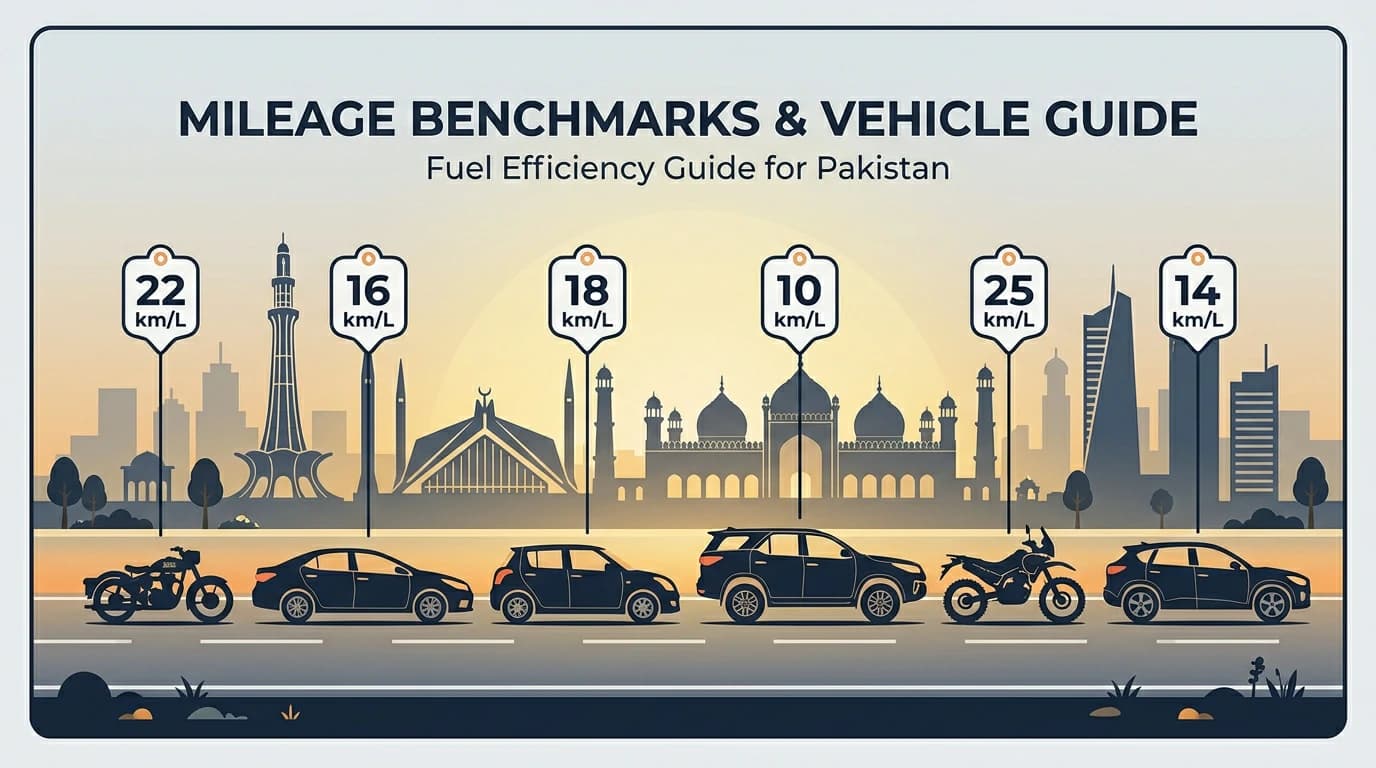
Expected mileage varies dramatically depending on engine displacement, transmission type, and vehicle wear. The table below outlines standard efficiency benchmarks and primary maintenance tasks for top models in Pakistan:
| Vehicle Model & Engine | Expected City Mileage | Expected Highway Mileage | Efficiency Category | Primary Maintenance Focus |
|---|---|---|---|---|
| Suzuki Alto (660cc) | 18 - 22 km/L | 22 - 25 km/L | Ultra-Efficient | Air filter replacement & Spark plug gap |
| Suzuki Cultus (1000cc) | 14 - 17 km/L | 18 - 21 km/L | Highly Efficient | Valve clearance and throttle cleaning |
| Toyota Yaris (1.3L) | 12 - 15 km/L | 16 - 19 km/L | Moderate | CVT transmission oil replacement |
| Toyota Corolla (1.6L) | 11 - 13 km/L | 14 - 16 km/L | Moderate | Oxygen sensor & fuel filter check |
| Honda Civic (1.5L Turbo) | 10 - 12 km/L | 14 - 16 km/L | Low-Moderate | Spark plug condition & Fuel injector flow |
| CD70 Motorcycle | 50 - 65 km/L | 60 - 70 km/L | Commuter-Max | Drive chain slack and air intake filter |
Why is My Mileage Low? Decision Tree
If your vehicle is delivering lower than standard fuel averages, follow this diagnostic decision tree to locate the root mechanical cause:
1. Check Tyre Pressure (Weekly)
Is tire pressure below the recommended PSI?
➔ YES: Low PSI increases rolling resistance, forcing the engine to burn more fuel to maintain speed. Inflate to manufacturer spec.
➔ NO: Move to Step 2.
2. Inspect Air Filter (Every 5,000 km)
Is the air filter dark or clogged with dust?
➔ YES: A clogged filter chokes the engine, disrupting the air-fuel ratio and increasing fuel consumption. Replace the filter.
➔ NO: Move to Step 3.
3. Check Spark Plugs (Every 20,000 km)
Is the engine misfiring or showing rough idle?
➔ YES: Worn or carbon-coated spark plugs cause incomplete fuel combustion, directly lowering mileage. Replace or clean plugs.
➔ NO: Move to Step 4.
4. Check Fuel Injectors & System (Every 40,000 km)
Does the vehicle hesitate during acceleration?
➔ YES: Dirty or clogged fuel injectors disrupt fuel atomization, preventing efficient combustion. Run a fuel system cleaner or service injectors.
➔ NO: Check wheel alignment, exhaust system restriction, or diagnostic trouble codes (DTCs).
Localized Driving Scenarios: Mechanical Impact
Environmental conditions and local terrains place distinct physical strains on your vehicle's mechanical components, directly influencing overall fuel economy.
- Karachi Stop-and-Go Gridlock (Mechanical Wear): Continuous low-speed crawling and heavy idling on Shahrah-e-Faisal cause rapid carbon accumulation on intake valves and spark plugs. This fouling reduces thermal efficiency and compromises fuel atomization over time.
- Lahore Canal Road (Optimal Efficiency): Steady cruising under steady loads allows the transmission to engage lock-up mode. This keeps engine RPMs low, minimizes cylinder wear, and promotes optimal fuel efficiency.
- Murree Steep Inclines (High Engine Stress): Climbing mountain inclines in 1st and 2nd gears runs the engine at high RPMs under maximum load. This increases cylinder wall friction, demands perfect cooling system performance, and burns fuel at accelerated rates.
⚠️ Avoid These Mechanical and Maintenance Mistakes
- ❌Using incorrect engine oil viscosity: Using thicker engine oil than recommended (e.g., 20W-50 instead of 0W-20) increases internal engine friction, dragging down fuel efficiency by 3-5%.
- ❌Ignoring worn oxygen sensors: A lazy or failing oxygen sensor sends incorrect exhaust gas data to the ECU, causing the vehicle to run a fuel-heavy ratio without triggering a check engine light.
- ❌Neglecting wheel alignment: When wheels are improperly aligned, they drag against the road surface. This increased resistance forces the engine to burn more fuel to maintain momentum.
- ❌Failing to service fuel injectors: Overlooking carbon deposits in the fuel rail leads to poor fuel atomization, preventing efficient fuel combustion.
How Driving Habits Influence Fuel Efficiency
Apart from mechanical maintenance, driving habits have a direct physical influence on km/L. Converting your calculated vehicle mileage into actual travel expense is essential when budgeting intercity journeys; learn more in our comprehensive fuel cost and mileage guide. Practicing smooth acceleration, anticipating traffic flow to avoid hard braking, and turning off the engine during extended delays are highly effective habits for preserving fuel.
Fuel Quality & Station Management
Fuel contamination and low octane ratings remain significant concerns in the local market. Poor-quality fuel causes pre-ignition knocking, forcing the engine's ECU to retard ignition timing. This timing shift directly reduces both engine power and fuel efficiency. To protect your fuel system, always purchase fuel from reputable, high-volume, branded retail stations.
Frequently Asked Questions
How does tyre pressure directly impact km/L mileage?
Underinflated tyres increase rolling resistance. This friction forces the engine to generate extra power to move the vehicle, which can decrease fuel efficiency by up to 5%. Check tire pressure weekly against the manufacturer's PSI rating.
How often should I replace my air filter to maintain good mileage?
In dusty local environments, inspect your air filter every 5,000 km and replace it every 10,000 km. A clogged filter starves the engine of oxygen, disrupting the combustion mixture and lowering mileage.
Why do worn spark plugs cause low fuel efficiency?
Worn or dirty spark plugs produce weak or inconsistent sparks. This weak ignition leads to incomplete combustion, wasting unburned fuel through the exhaust system and significantly reducing km/L mileage.
How do I clean dirty fuel injectors for better fuel average?
Use a high-quality fuel system additive every 5,000 km to clean mild injector deposits. For severe clogs or mileage drops, have a certified technician perform professional ultrasonic cleaning on an injector test bench.
Disclaimers & Notes: Actual vehicle mileage depends on driving style, traffic conditions, payload, terrain, and regular mechanical maintenance. Maintenance schedules must align with your vehicle owner manual specifications.
Last Updated: August 7, 2026 | Author: Abaid Awan | Reviewed by: Abaid Awan (Automotive Editor) | Reading time: 8 min | Sources: Manufacturer owner manuals, certified laboratory tests | Contact: contact@pakcalchub.com
Abaid Awan
Developer & Editor, PakCalcHubDeveloper & Editor of PakCalcHub. Specialized in microsecond client-side calculation models and statutory FBR/NEPRA/SBP formula verification.
Calculate Mileage Calculator km/L Instantly
Zero signups. Microsecond client-side calculations based on latest Pakistan statutory rules.
Salary Tax Calculator Pakistan 2026-27 & 2025-26
FBR salaried tax slabs 2025-26 & 2026-27 with return filing
Use CalculatorRecommended Knowledge Guides
Explore verified Pakistan tax, utility, property, and financial guides.